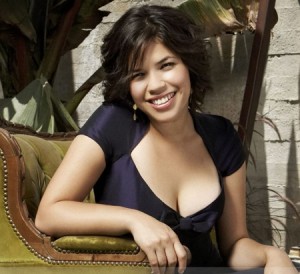

America Ferrera
"Betty's Beautiful Now!"
After making her breakthrough role in the HBO film Real Men Have Curves, America Ferrera shot to TV glory with her role as geeky main character Betty Suarez on the ABC TV series Ugly Betty, while also achieving success in film with roles in The Sisterhood Of The Traveling Pants movies, Lords Of Dogtown, and How To Train Your Dragon.
With Ugly Betty having now ended this past season, the 26 year-old plays what is inarguably her most dramatic role yet as Sarah, the wife of a traumatized Iraq War veteran, in the drama The Dry Land. Ferrera was asked whether Sarah is indeed the most emotionally-challenging role by far in her career.
“I don’t think I can really compare it to anything else that I’ve done,” America says, “I feel like every role that I take on, I take on because it’s a challenge to me. I would say that this is probably the most grown-up role that I’ve gotten to play, which is exciting for me, and clearly the most presently important and serious role that I’ve gotten to play that has such an immediate resonance to what’s happening in our society right now. But it was challenging and it had its challenges, but in some ways, I feel like I could relate to Sarah more than to some other characters that I’ve played.”
“I think that because I’m not a woman who has a husband at war, I really did connect to this character on a human level that, as a woman, I could understand what her journey was outside of the military complex,” she adds, “It’s a woman who had a partner in life, a best friend, a husband, someone to share her life with, who then is inaccessible behind his eyes. How do you get him back? How do you find that person that was supposed to be there forever? And that felt like an easier thing to relate to than how would
America Ferrera
"Betty's Beautiful Now!"
I feel if my husband went to war. I don’t think I could go there. I went to the easier place to go to, which is how somebody I cared about so much got lost behind their eyes and all I wanted to do was just see them back behind those eyes again.”America says she had originally intended a more limited, behind the scenes role on The Dry Land as an executive producer, but grew attached to Sarah as she went through numerous actresses for the part.
“I had set on solely being the executive producer on it, didn’t have any intention of playing Sarah and actually offered the role to many of our friends, hoping they would attach themselves and help get it made,” she says, “I was there from the beginning. And I think, as an executive producer, before I intended to play Sarah, I got to look at the picture as a whole and I had to. And I had to think about James, our lead character and what we wanted to feel from him, and what role each character played in bringing out the side of him that we wanted to see and what propelled his journey forward. So I kind of came from a macro point-of-view of who is she in the realm of this film to really falling in love with this strong female character that just had love and compassion and wanted to heal her partner with love and strength and be the sole thing to bring him back and hold him up. And so desperately wanting to succeed in that and feeling like she feels, I fell in love with the role that she played in this story.”
“And then, when I decided to play her as an actor, then I got to just focus on her solely,” Ferrera continues, “:And by that time, [writer/director] Ryan [Piers Williams] had so many conversations about the film as a whole. Each
America Ferrera
"Betty's Beautiful Now!"
character, Raymond’s character, Michael’s character, Clive, the dog, who plays such a huge part in the movie. So, then, I had all these other conversations as a producer that gave me such perspective and then, it was just such a treat to go in and focus and zoom in on Sarah. The way I prepared for that is I got to talk to a lot of women whose husbands had come in with PSTD essentially.”Ferrera says that writer/director Ryan Piers Williams gave the film the authenticity it needed to get the support of the US Army in providing resources for the film.
“This was all because Ryan Williams, our director, his vision, his intent was to tell a story that was authentic, a story that a soldier or a soldier’s family member could sit and watch and say, yes, that feels true, that feels authentic, that feels real to me,” she says, “He wanted each of us as actors to do that work and take that on and feel that obligation to be authentic and not act this thing as a Hollywood actor might.”
“You should know, but act it for them, act it so that they could look into you and say, that’s me,” America continues, “He submitted the script to the U.S. army so he could get their support and we were so blessed that they gave us their support, which essentially meant that they opened up so many resources to us. We were able to shoot at Walter Reede, at William Beaumont hospital, they were able to train with the National Guard.”
America also says the Army provided her with research and access to dozens of army wives who told their story of what they had went through with their returning veteran husbands.
“They literally handed me phone numbers of women who were willing to talk to me, to prepare for my part,” Ferrera recalls, “And I spoke to women in different parts of the country
America Ferrera
"Betty's Beautiful Now!"
and had a lot of very open and candid discussions. The women that I spoke to, it started out tentative and by the end, it was just like pouring out, it was just coming out because their whole other side of the coin, which was just…The focus that we do put on the war is towards the soldiers and not very often towards the family members and the spouses who sacrificed so much for that soldier to go away and support the family and be all things to everyone in that moment and also be constantly in fear that your loved one is in danger. And so, it was interesting talking to them and hearing cases where it ended in the worst case scenario and cases where it ended in the best case scenario where a soldier said, yes, I need help, and went and it save the marriage and they are moving forward. And that’s not easy and sunshine and roses, but they were finding a way to move forward. So we know that that’s possible, that there is hope possible, and that ending is possible. And also, more times than not, it went in the other direction.”“My deep compassion and sympathy for these women, like I said, was it was less about, I now know what it feels like to be a woman whose husband goes to war. It was on a much less complicated level than that,” she adds, “It was more about these women feel invisible and they feel like no one sees them. When a soldier goes, it’s how are they, when a soldier comes home, it’s how are they. No one says, do you feel like you’re ready to give up on being all things to your own family and to this person. Then, when that person comes home, and this is one of the things I will never ever forget is one women said to me, ‘I
America Ferrera
"Betty's Beautiful Now!"
allowed myself the thought of would this have been easier if I didn’t come home?’ And that’s incredibly heartbreaking when we as the outsiders think, they come home and they’re safe, end of story, happy ending, they came back. And then, as Wilmer [Valderrama] likes to say, it’s the second war that they fight. They fight a war and they come home and it’s, ‘How do I get my life back? How do I stay intact?’ And what I wanted to portray was say I was a woman who loved this man, who thought he was still in there, fought for him and tried, but there’s a certain point, when is it PSTD and when is it domestic violence? When is it PSTD and when is it putting yourself in danger?”Ferrera also shared her most difficult scene shot during the film.
“There was a lot of difficult scenes,” America says, “But I think for me, it was the bathroom scene, the scene where Sarah’s trying to connect to James (Ryan O’Nan’s character) on all sorts of levels, trying to talk about it and that doesn’t work and trying to appeal to him affectionately and sexually and that doesn’t work and just the heartbreak of a woman trying everything to get in there.”
“How do I feel a semblance of who you used to be, how do we get back to that and failing at that, and defeat of I don’t know if I can win this and she can’t by herself,” she continues, “It takes having to let go and ask for help and acknowledge that before any of that can be done. And that’s when a lot of family members take on the guilt of, ‘I don’t know how to heal this person.’ Nobody can heal them. They have to ask for the help before anything can be done.”
America says she had The Dry Land screened on military bases for actual soldiers serving in Iraq and
America Ferrera
"Betty's Beautiful Now!"
Afganistan.“We went to Iraq,” she says, “When we went there, we didn’t screen the film there. We did talk about it a lot with the soldiers there and in some cases, we showed them a trailer there so they had some idea of what it was. We were mainly there to meet and greet and say hi and talk. But just a couple of weeks ago, we screened the movie on the installation at Fort Carson for approximately 600 to 700 active-duty soldiers and their spouses, soldiers that just came back from Iraq and Afghanistan or were going in a matter of weeks to Afghanistan and Iraq.”
“That’s when we really got the experience of showing it to a large group of soldiers,” Ferrera continues, “And the response was just amazing and sparked really interesting questions and conversations and hours of sort of one-on-one, them wanting to share their version of the story with us. And for us, I think it was the ultimate reward to see the film do what we all believe it could do, which was really relate to the soldiers and their families, the people that the movie is about, and also, spark a conversation among them and make them feel like it was a compassionate portrayal and not a judgement or a politically-skewed or driven film that had a certain agenda.”
Ferrera also adds that it wasn’t just Americans that could relate to the film.
“We took this film to the Edinborough Film Festival and it won Best International Feature,” she reveals, “The Q&A afterwards was just as reactive and responsive and just in Scotland alone, they’re having a huge problem with a huge percentage of incarcerated men being returned soldiers.”
“We clearly have to deal with it domestically and at home,” America adds, “But the conversation that’s local, we send, prepare, and we train and send men to fight and how do we bring them back to this life, to society, to help
America Ferrera
"Betty's Beautiful Now!"
them transition and it was really powerful to see how it transcended international borders and it was important in that country, too.”America says the feedback she got from soldiers and regular civilian audiences often differed from one another.
“With this film particularly, our biggest hope is to show it on military bases around the U.S. and we’ve already shown it,” Ferrera says, “We’ve shown it to approximately 600 to 700 active duty soldiers at Fort Carson. And after that, I hope to continue to do that and start those Q&A’s. Also, as a companion to that, showing it to non-military communities, just in civilian audiences, so those bridges start to be built because what we found in Fort Carson, we screened it on the base at the beginning of the morning, then we had lunch, then we screened it in a local theater for civilians in the afternoon and there were two completely different conversations being had.”
“And yet, you sensed from the civilian community a desire to want, an interest to be piqued, ‘What do I do? How do I help? And do they want my help? And what’s the best way to help?’” she adds, “So you could see that there was those things being bubbling on the surface. People care, but so many of us don’t know where to begin and how do we start being involved, and so those are the conversations we hope to continue to inspire in local communities as we take this on the round.”