




Cary Elwes
Cary Elwes
Interview By: Jeff Wilser
JeffWilser@TheCinemaSource.com
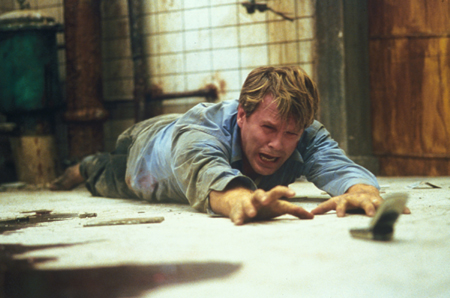
In the new horror Saw, Cary Elwes is chained to a wall by a deranged serial killer. His only company is a complete stranger and a dead man. Sweating, afraid, and paranoid about what might happen to his family, his character squirms for hours and dreads his doom.
He’s in a better mood in real life. Maybe he thinks I’m better company than a dead man. That’s debatable, of course, but either way, he was kind enough to sit down with TheCinemaSource to discuss his role on Saw, why he was happy to work for no pay, and to gush about Saw’s two creators, James Wan and Leigh Whannell.
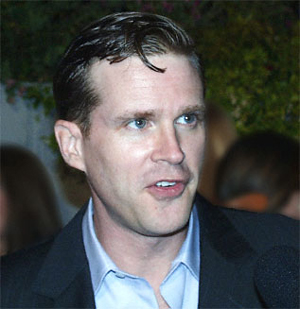
Wearing a blue sweater-shirt, glasses, and with his blonde hair neatly parted, Elwes looks something like a real-life Ken doll. He smiles as he shakes our hands, then glances back at the door where James and Leigh had just left. “So how do you like these guys? They’re hysterical, aren’t they?”
They are. (Click here to read the interview with James and Leigh.) During publicity, all actors say the right things about their movies. It’s part of the job. With Elwes, though, you get the feeling—a rare one—that he’s not full of it.
In fact, their energy is why he hopped aboard the indie-film. Before he had even heard of this obscure duo from Australia, he watched a short DVD that they had created to pitch the movie. “You could already tell from the way that James shot it—and the way that he cut it—that that it was interesting,” Ewes says. “And then when this doll came out—on a tricycle—I just went, ‘What the heck is that?!’ And I sent back an e-mail to the producers with just one word: ‘Wow!’ Exclamation mark. And then they sent me the script,
Cary Elwes
As Elwes speaks to us, he sounds like a proud father talking about his talented son. If he was impressed by the demo, he was blown away by James’ boundless creativity and his attention to detail. “He’s a very talented artist. He had these watercolors and drawings of the sets, and he knew exactly how the bathroom was going to look, right down to how dirty the urinals were!” He laughs, but all of us at the table are just an ittsy-bit squeamish, since one memorable scene has a character plunge his hand down the toilet in a search for clues.
“He already had the costumes, the pig face, and the little doll, of course, which he made himself, out of paper machete and ping-pong balls. He’d already drawn the poster. He already knew how to sell it. Which I was very impressed with. Because I know from studying Kubric that if you’re a filmmaker and you understand that your film is not over, not even in the marketing aspect of it, then you care about your baby. You know what I mean? So I was really impressed with that. He clearly had a very strong vision that he wanted to put across the screen, and I said, dude, you can count me in.”
Elwes is an unlikely choice to star in a horror film, but the chance to play this particular character intrigued him. “I hadn’t really done horror since Dracula,” he says, “And I’d not really played a victim for a long time. I mostly get cast in the bad guy roles or the smug character. This was a bit of both. This was a character who was both smug and self-involved and conceived, and had become complacent, both in
Cary Elwes
The final version of Elwes’ character is slightly different than what was originally in the script. During the shoot, he worked with both James and Leigh to flesh out his character, to amplify the personal story arc. “In the script originally,” Elwes says, “The character started out very calm. When you first hear Dr. Gordon’s voice, it’s very calm, you don’t know who it is talking, you don’t know if it’s the killer or who it is talking to Adam. He’s being all calm and trying to be the paternalistic character. And I said, what would be really interesting is if throughout the movie they change places, that the guy who started out all relaxed ends up being a basket case by the end. So we worked that a little bit more.”
They had only 18 days to shoot the film. Surprisingly, in many ways that turned out to be a blessing. “I love a challenge, and I’d done some television, which helped prepare me for that. And it doesn’t give you a lot of time to sit and think. If you’re sitting around a set on a big-budget movie, actors can get inside their heads and start thinking of eighteen billion ways to play a scene. The immediacy of not having that—what might be considered a luxury—to me, was refreshing. It was like the Nike logo, Just do it. And I think it proved to be effective. Certainly for me it helped. I didn’t have to draw too much on sense of memory, because I was just in the moment. It allowed me to keep the engine running, instead of turning it off and then starting again. Because that can be exhausting. Sometimes the car
Cary Elwes
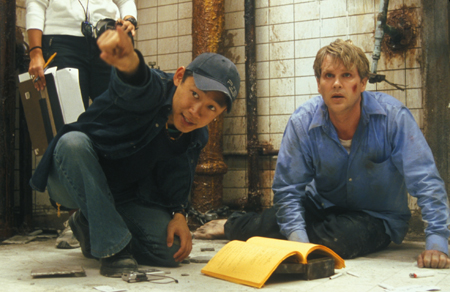
It was an intense shoot, a grueling schedule, and certainly not the most comfortable set (remember, he’s chained to a wall the whole time), but a spirit of camaraderie prevailed. “All the actors were so professional,” Elwes says. Look, none of us got paid for this thing. We all showed up because we were so passionate about it. If you have an ego then you’re forced to check it at the door. There’s no time for any of that. We hit the ground running in only 18 days. You’re either in it, and you want to do it, or you’re going to be in the way. Luckily we were fortunate to get wonderful actors who were all passionate about it.”
That applied not just to the actors, but to the crew, as well. “We were very fortunate. Everyone was wonderful. Even the crew. I’ve worked on a bunch of movies now, and most Hollywood crews are a little bit jaded. You know what I mean? And these guys worked so hard. I’ve had early calls, but some these guys were working through the night. The scene painters, the props people, costumes, set design, you come in and these guys are just sweating it—slaving all night, but still manage to make a smile. It just gets you right here.” He thumps his heart. “It just gets you.”
