


Bon Voyage
Director: Jean-Paul Rappeneau
Cast: Isabelle Adjani, Grégori Derangère, Virginie Ledoyen, Gérard Depardieu, Yvan Attal, Peter Coyote
Genre: Comedy/Drama
Rated: PG-13
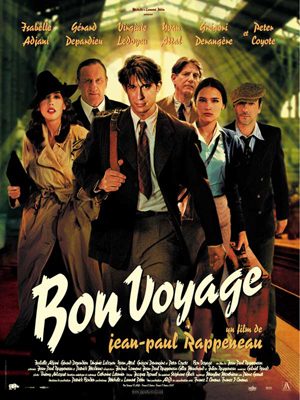
Bon Voyage
Review By: Staff
Staff@TheCinemaSource.com
Bon Voyage
Review by: Alysa Salzberg
Alysa Salzberg@TheCinemaSource.com
History is never simple. Least of all the history of France during World War II. Far from the quitters we Americans tend to portray them to be, the French were a people divided "” or shattered, more like, by the war and its consequences. Some lived under German occupation in the north, and even collaborated with the Nazis to do terrible things. Others formed the Resistance, and fought desperately for liberty and freedom. Still others fled to the south of the country, where France was allowed to maintain its own government (albeit one that also collaborated with the Germans). The motivations behind each person's decision can't be simply explained. In Jean-Paul Rappeneau's film Bon Voyage, which opened in France last year and is now making its American debut, we get a glimpse of life just at the start of the war, and see a group of individuals making their choices as to where they stand, or sometimes even being unwittingly led into them. It's a serious situation, sure, but Rappeneau's movie sparked controversy in his native country by taking these serious issues and showing them at times in a lighter way, making them at times no more than the turbulent background of a delightful crime caper.
At the start of Bon Voyage, sultry screen star Viviane Denvers (Isabelle Adjani) is in big trouble "” one of her lovers came to her apartment and started harassing her, and one thing led to another, and, well, now he's dead. Desperately she calls Frédéric (the handsome Grégori Derangère), a writer and childhood friend who's had a crush on her all his life. She convinces him to help her stash the body, and as things like this often work out, Frédéric gets caught (one of the funniest scenes in the movie) and sent to prison. A few months later, the Germans are invading, and the prisoners are handcuffed in pairs and taken into transport trucks to go to a prison further away. Luckily, Frédéric happens to be handcuffed to Raoul (Yvan Attal), a born criminal who drags the unwitting author to escape. Now they're headed out of Paris on the last train. Crammed among the refugees is Camille (Virginie Ledoyen) an assistant at the College de France. Though she looks like (and is) a sweet young thing, there's more than meets the eye to Camille, and when the trio arrive at Bordeaux, where a huge portion of the French population has fled for refuge, things only get more complicated. Soon, the hapless Frédéric is involved with petty crime, government corruption, and a secret that could mean the end of the free world.
The tangled plot may sound complicated, and the fact that further
Rappeneau is a highly respected filmmaker in France, and his whole cast seems thrilled to be working with him. Each actor seems to give his all to his part, and the characters come vividly alive. When the movie finishes, though some plotlines are tied up neatly, others are left somewhat open-ended (often a case in French ensemble cast movies), yet after getting to know these characters, you seem to understand what will happen to them as though Rappeneau's whispered it in your ear.
"ÂBon Voyage"Â is an expression meaning "Have a good trip"Â, and here it makes for a brilliant title. We don't follow these characters through the end of the war; rather, we see things just beginning. The title seems like a benediction, then. But it's also a bit tongue-in-cheek. After all, we the viewers know what horrors await most of the people of Europe in the coming years. Besides this, one of the times the titular role is spoken is when Viviane, oblivious to what is going on, says it to a real-life historical figure who's about to make history. In this way, the title perfectly sums up the film. We get glimpses of the fear and persecution felt by all people during the second World War (including the knowing worry of one Jewish character), but we also see flickers of hope. Though some of the film's devices may be seen as heavy-handed at times (using a novel to symbolize one phase in someone's life, for example), Rappeneau gives us an agile, interesting film, beautifully shot and masterfully acted. I highly recommend Bon Voyage to anyone. It's best if you can see it in a theater, since it includes many scenes of audiences in movie theaters (another device that could seem heavy-handed, but, considering the tone of the film, ends up working). An exciting and often hilarious story, crammed with great characters, intrigue, pratfalls, romance, and adventure, Bon Voyage transcends genres, enabling us to see a part of history in a way that essentially and amusingly captures man's chaotic emotions at the dawn of war.
Movie Grade: A