


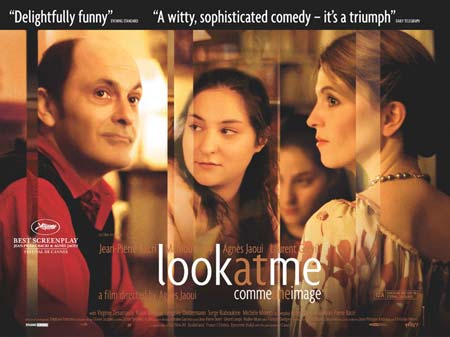
Look at Me
Director: Agnès Jaoui
Cast: Marilou Berry, Jean-Pierre Bacri, Agnès Jaoui
Genre: dramatic comedy
Rated: PG-13

Look at Me
Review By: Staff
Staff@TheCinemaSource.com
Look at Me
Being The Cinema Source's Paris correspondent, friends and colleagues often ask me"¦well, if I can bring them a box of chocolate next time I come to the US. But besides that, now and then I also get this question: What is a typical modern French movie like? As fans of French cinema know, though the movie industry here may not be as big as America's, it's definitely diverse. Homegrown celluloid offerings can range from contemporary dramas, to costume pieces, to (often more intellectually-toned) popcorn flicks. But a common thing that seems to run through a majority of French films is a certain tinge of sadness and contemplation. The "good guys" may win, the lovers may end up together, but other characters will probably go on suffering, or at least their stories might not be neatly wrapped up. Call it the French touch – in fact, a completely trouble-free finale is so foreign here, that when talking about movies, the term "happy end" is often just said in its original English!
This week, Cinema Source readers in L.A. and New York will have the chance to see Look at Me (original title: Comme une image), which has had great critical and popular success (it's one of the biggest domestic hits of the year) since it was released in its homeland back in the fall.
The movie, co-written, co-starring, and directed by engrossing storyteller Agnès Jaoui, gives us a glimpse into the life of upper-class Parisians Lolita Cassard (Marilou Berry — an award-winning rising star whose talent is only added to in my opinion by the fact that she looks like my slightly heavier French cousin) and her father Etienne (the charmingly jackassy Jean-Pierre Bacri, Jaoui's real-life husband and the film's co-writer). He's a famous author who's cruelly narcissistic, and she's his oft-ignored daughter who's currently in training to be an opera singer. Add to this a number of supporting characters, from a writer experiencing his first literary success (Laurent Grévill), to Etienne’s new flame (Virginie Desarnauts ), a gorgeous girl barely older than Lolita, to Lolita’s reluctant music teacher (Jaoui), and you get a movie full of stories big and small. But the most important of these stories is that of Lolita’s and Etienne’s relationship, which discreetly serves as a lens through which we see how their dealings with the other people in their lives are tinted, tainted, and influenced.
Look at Me is about people and daily life, but there's nothing common about it. At first, like many French films of its type, it probably won't seem like much to most Americans. We're used to flashiness, cool marketing, and slick visuals from our movies. But as is the case with flicks of another era in the US, or, say, Woody Allen
Besides Jaoui's skillful directing and her and Bacri's writing (the screenplay was named Best Script at last year's Cannes Film Festival), the movie's honesty and feeling are made palpable by Berry and Bacri, who play their roles with ease and naturalness. It's in her character's quieter moments, when the camera looks on like a fly on the wall, that Berry especially shines. But what causes Look at Me to be a truly remarkable cinematic experience are the things that lie just beneath its surface. The original title of this film, Comme une image, literally translates as "Like an image"Â. Like any great title, it works on a number of different levels. How alike are even the most seemingly different people? How alike are Lolita and her father? What is the image we project to the world? And, maybe most importantly, how much does our outer skin influence those who might, or should, love us? The rare answers the movie might seem to give us are never easy, and are frequently heartbreaking.
Look at Me will probably have you laughing at times, but you'll also have tears in your eyes and a slightly unsettling batch of questions running through your mind, by the end. But, ah, savor these questions, my friends; a few minutes after leaving the theater, you'll be discussing them with your pals, and the conversation and debate might just be so engrossing that you'll need to stop in at a bar or café to finish it over some coffee or a nice wine. Introspection, philosophy, and a good beverage – more French specialties that can be just as delicious as chocolate.
Go see Look at Me for a taste of what's going on in the best of French cinema today. But as you're touched, moved, and challenged by its wit, subtlety, and profundity, you're bound to get the feeling that what you're seeing here is la crème de la crème – the best of the best – not only of contemporary French cinema, but of contemporary cinema, period.
Movie Grade: A+
_____________________________________________________________________________
About the Movie
This is the story of Lolita Cassard, a young woman of twenty years who has it in for the entire world because she doesn’t look like the girls in glossy magazines, who doesn’t look a thing like her young mother-in-law, and who would so much like to feel beautiful, at least in her father’s eyes, if only her father’s eyes could find her. But this is