


My Soul to Take
Director: Wes Craven
Cast: Max Thieriot, Nick Lashaway, Zena Grey, Denzel Whitaker, Trevor St. John, Shareeka Epps
Genre: Horror
Rated: R

Review By:
Lee Loechler
School:
New York University - Tisch '12
Quote:
"I love deadlines. I like the whooshing sound they make as they fly by." -Douglas Adams
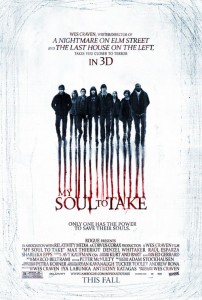
My Soul to Take
Review By: Lee Loechler
LeeLoechler@TheCinemaSource.com
Wes Craven has made a name for himself as one of the preeminent horror movie writer-directors of the last few decades. And with a resume including such horror icons as The Hills Have Eyes, A Nightmare on Elm Street, and the Scream movies, it’s not hard to see why. But there are a few points that suggest My Soul to Take will be a different fare. For starters, its the first film since 1994′s Wes Craven’s New Nightmare that Mr. Craven has both written and directed. Additionally, it is Mr. Craven’s first foray into 3D cinema, although it is worth noting that the film was shot in 2D and later converted . Which is unfortunate because 3D is likely the film’s strongest selling point.
My Soul to Take begins by introducing a schizophrenic serial killer, ‘The Ripper’, who is apprehended by police after killing his wife, suffering multiple stab and gunshot wounds, and generally having no coherent medical reason for his continued pulse. The incapacitated Ripper comes to in an ambulance en route to the hospital, and kills the medical staff on hand, causing a spectacular car crash that flips the ambulance end over end towards a river bank. As police arrive on scene, the ambulance inexplicably combusts. Despite all of these factors, everyone seems certain that the Ripper (or at least his soul) has survived and will be return to take a new body and kill again.
Now this is just the exposition, but it is very indicative of the rest of the movie. There is a consistent lack of coherence throughout the film — a by-product of establishing a world with rules that draw from different horror cliches at different times, and has no semblance of consistency when using them. We are lead to believe, for instance, that this is a modern day film taking place in an average country town in rural Massachusetts. But the police seem to have no trouble accepting the fact that a dead serial killer can possess the body of a mild mannered teenager and continue his psychotic rampage. It’s a film about this type of supernatural horror goings-on, but the characters seem to live as though these are not strange things. When the serial killer inevitably returns from the dead 16 years later (which is a well known fact amongst the community, as if it’s obvious that the stabbed, shot, and incinerated psychopath will return from the grave and begin to kill the seven 16-year-olds who were born the day he died…. somehow, this is just general knowledge.) he does indeed begin to stalk and kill the ‘Riverton Seven’.
The Riverton Seven are seven kids from the local high school who share the same birthday as The Ripper’s obituary. One of them is our protagonist, Bug, played by Max Thieriot. Bug is a sensitive and troubled only-child, who, in typical
Why does Bug have the ability to channel the personalities and speech patterns of the other 6 kids? Why does looking into a bathroom mirror allow him to see the dead? And since we know the ripper is one of the seven kids, why does he talk like a 40 year old chain-smoker and suddenly become 7 feet tall and 250 pounds when disguised by a big coat and a Rastafarian wig? And what kind of kid climbs into a second story window to enter his room? And why are all the popular girls at school secretly a well organized crime family? And what kind of a name is ‘Bug’???
These are just a few of the questions I found myself asking as I watched the movie. It’s like watching a collection of every idea Wes Craven has had in the last 16 years that haven’t found their way into other movies. It’s a poorly structured film, and at times it is actually laughable how little it makes sense. the main selling point remains that the film is offered in 3D, but this is really more of a detraction since it’s not true 3D, and the parallel projections cause the image to be twice as dark as it would be otherwise. Combined with the usual horror flick aesthetic of dimly lit spaces and night terrors, this makes My Soul to Take hard to watch physically as well as mentally.
This is not Mr. Craven’s best work, and I would suggest fans of the horror genre (and indeed film in general) to pass this one up. Or if you’re a fan of terrible dialogue, there are a few particular choice lines, my favorite being: (Out of nowhere, Wounded Cop shoots The Ripper as he attempts to maul Defenseless Female Cop) Wounded Cop: “That’s for shut the f*ck up!”