


The Perfect Age of Rock and Roll
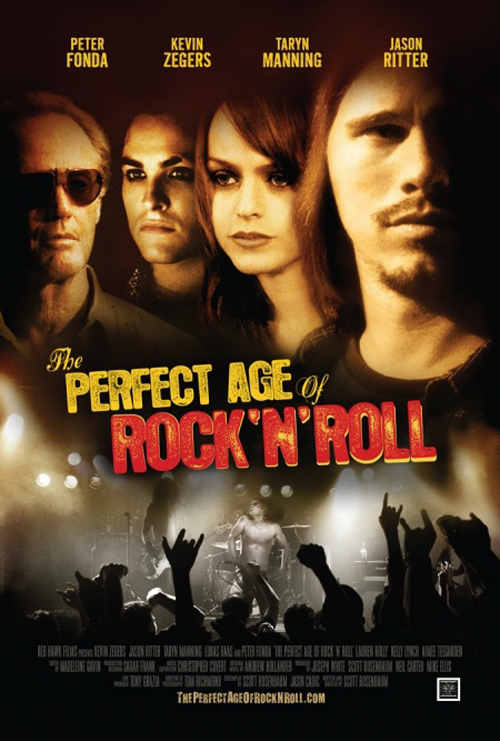
Cast: Jason Ritter, Lukas Haas, Kevin Zegers, Taryn Manning, Lauren Holly, Aimee Teegarden and Peter Fonda
Rated: R

Review By:
Kieran Newton
School:
Fordham University '15
Quote:
"I am Ozymandias, king of kings: look on my works, ye mighty, and despair!" -Percy Bysshe Shelley
The Perfect Age of Rock and Roll
Review By: Kieran Newton
KieranNewton@TheCinemaSource.com
Normally, I’m pretty excited to do reviews. But for some reason, I’ve been putting off my review of The Perfect Age of Rock and Roll for a few days now. I didn’t mean to do it. It just sort of happened. I found myself just not wanting to review this movie. It wasn’t that it was awful—those of you who frequent my reviews certainly know that I love tearing apart films whenever they rightly deserve it. But it’s just that this film was so very, very…bland, that it warrants no interesting, thoughtful, or original criticism. As such, I will now proceed to fill this review with as many clichés as I possibly can, in order to more properly fit the subject material.
Right out of the gate, the film was dressed to impress: it had Jason Ritter, whom I am familiar with primarily from NBC’s latest mindf**k show, The Event, in which he was the only consistently decent part. I mean, he’s no Leo DiCaprio, but he was always at the very least entertaining. Or so I thought. In TPAoRaR, Ritter plays Eric Genson, a downtrodden music teacher at the local elementary school. He’s still living at home, as well as in the past. He’s not a pretty sight (although the movie desperately tries to make him into this prettyboy sex icon, or something, which I don’t understand). When his friend Spyder (Kevin Zegers) shows up, his life is changed…forever.
See, the preposterously-named rock star Spyder and Genson used to be childhood friends, as well as band mates. They wrote a few songs together (read: Genson did all the work and Spyder sang) and then Spyder backstabbed Genson, taking his demo and running with it to California, where it became the phenomenal hit debut album of Spyder’s new band, The Lost Soulz (again, I think the writers need to apologize for the name). The second album, which Genson had no hand in, was a flop, and so now that they are planning to record a third album, Spyder and the ‘Soulz need Genson’s help. The year…is 1991.
See, the movie actually takes place in 2011. We find out all these things through the startlingly accurate story being told through frame narrative. A rather pesky reporter, the again-ridiculously-named Clifton Hangar (Lukas Haas), has finally been granted an interview with Spyder, who dropped off the face of the earth twenty years ago and hasn’t been heard from since. Spyder’s memory must be as sharp as tacks, because he remembers every little detail of the events, even the ones where he wasn’t even present. Now THAT’S a talent if I’ve ever seen one. Truly, he has a dizzying intellect (name that reference!).
Except he doesn’t. Every moment Zegers is on screen is, while not necessarily so bad as to warrant a “painful,” definitely “forgettable.” His one talent is that he does in
See, a movie should not be able to put me to sleep as it nears its finish. I’m not going to lie, there are a good amount of slow movies that I’ve had to struggle with for the first half hour or so, but after that, I get really invested in the characters, and the end becomes riveting. The Perfect Age of Rock and Roll had an inverse effect: I cared less as time went on. And now, to cap off the review, I will give you a list of some of the incredibly trite elements present in this painfully average film.
Shouted altercations in the rain, followed by a muddy wrestling match. An angry band of bikers. A roadtrip montage complete with a “show us your tits” sequence. A campfire scene with one of the characters expounding on the meaning of the universe. A “tense” scene where the tortured rock star talks about his abusive father. Drug habits ruining everything. A blues jam session in an entirely African American bar-thing, where everybody is surprisingly happy to have two white boys play the blues for them. Peter Fonda, being delightfully bland. And perhaps most insulting, not one, but two ironic slow claps.
*sigh* We deserve better, Hollywood.
Synopsis:
A rock star retreats to his hometown after his sophomore album flops.