


The Rum Diary
Director: Bruce Robinson
Cast: Johnny Depp, Amber Heard, Aaron Eckhart, Giovanni Ribisi, Richard Jenkins, Amaury Nolasco
Genre: Adventure, Drama
Rated: R

Review By:
Kieran Newton
School:
Fordham University '15
Quote:
"I am Ozymandias, king of kings: look on my works, ye mighty, and despair!" -Percy Bysshe Shelley
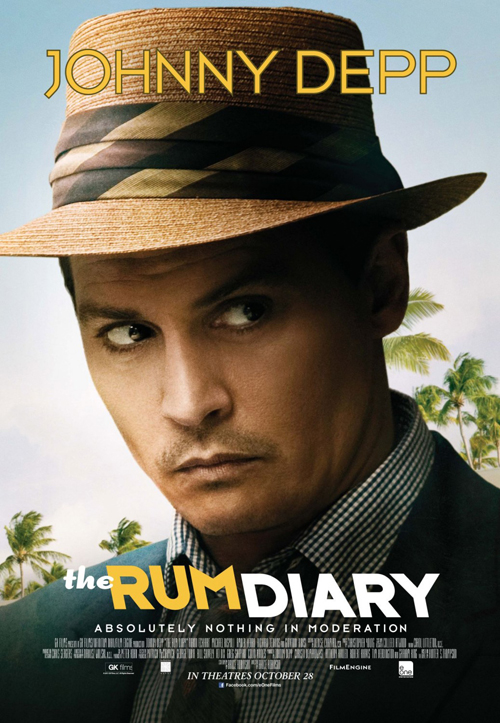
The Rum Diary
Review By: Kieran Newton
KieranNewton@TheCinemaSource.com
Disclaimer: no, I have never seen Fear and Loathing in Las Vegas. No, I have not ever read any of Hunter S. Thompson‘s large, drug-induced portfolio. Nonetheless, I’d heard good things about both, and both the book and the movie of the above title are on my to-read and watch lists, respectively. However, if it’s anything similar to The Rum Diary, a book also based on Thompson‘s sobriety-free travels, I’m not precisely sure I want to. The Rum Diary is long, it is meandering, and honestly, it left me thoroughly confused.
One of the main reasons for my confusion is the story. On my way home from the screening, I bumped into a friend who asked me what the movie was about, and honestly, I couldn’t do much better than, “Johnny Depp is a journalist who goes to Puerto Rico to work for the newspaper there, and then…gets really, really drunk.” My friend stared at me quizzically. “That’s it? Is there a plot?” And honestly, if the film’s goal was to recreate a sense of intense inebriation, it certainly succeeded, because for the life of me, none of the story really stood out in my mind. I know Aaron Eckhart is in it as a twisted real estate developer, and that Depp seems to be trying to expose the…deep…moral…problems of the island. Or something. It’s all very vague.
What I do remember is the alcohol. So much alcohol. It’s almost staggering how little vomit is seen or even alluded to in the film, considering the vast amount of liquor that is consumed, starting at minute 3 of the film and ending maybe 5 minutes before the end. That’s not to say there isn’t some entertaining stuff going on—there are sequences of fire-breathing, there’s racial tension, there’s a very,very beautiful love interest in the form of Amber Heard, and there’s a lot of pretty crude humor along the way. I’m not saying that in a bad way—that’s just what the movie is, and if you take it as it is, it’s a lot of fun; until it grows a conscience.
See, the really weird part of the movie is that it seems to have a political message—it takes place in the early 1960′s, communist tensions are very high, and there’s a palpable uneasiness to the scenes in which politics are discussed. Hell, Depp‘s lead character spends the majority of the movie trying to get a story published about the plight of Puerto Rico, about the disillusionment he experiences as he sees the true nature of the island, as opposed to what newspaper editors and TV crews want America to see. There are only two problems with this, the first being that it’s rather vague as to what its message is. If you’re going to attach political significance to a film, you have to make it potent and readable; I’m
That’s not to say the acting isn’t top notch, because it is. Each character, especially when drunk, is quite believable, and not simply “acting drunk,” which isn’t how drunk people act at all, but rather “acting drunk trying to be sober.” This is pulled off quite well. There is a mix of cinematographic styles, with good effect but very little consistency. There are certainly shots that stand out, but they aren’t the ones that were difficult to pull off, and it begs the question as to why director Bruce Robinson didn’t decide to use such creativity throughout the otherwise very critically boring film.
The music is fantastic, though, and it’s worth watching the movie just for some of the various, wonderful aspects of the score, ranging from classic blues-rock guitar, to spicy tones with a very riqueza feel, and the use of a single, walking upright bass that is absolutely divine. It certainly fits the feel of the film, kind of ambling from one ridiculous scenario to the next, and yet tying it together enough to keep the audience interested and entertained. At the end, though, the audience can clearly see the strings.
The main problem is that all of the conflicts of the film—the writing one, the political one, the romantic one—are never truly resolved, there is no cathartic release, there is no happiness or despair, there just…is. At the end, it feels like you have a mild hangover—there’s an odd sensation of irritation and discomfort, and even regret, and yet you haven’t the slightest idea why.
Synopsis:
American journalist Paul Kemp (Depp) takes on a freelance job in Puerto Rico for a local newspaper during the 1950s and struggles to find a balance between island culture and the ex-patriots who live there.