


The Triplets of Belleville
Director: Sylvain Chomet
Cast:
Genre: Animation
Rated: PG-13
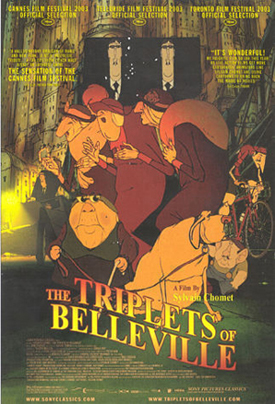
The Triplets of Belleville
Review By: Staff
Staff@TheCinemaSource.com
The Triplets of Belleville
Review by: Alysa Salzberg
(AlysaSalzberg@TheCinemaSource.com)
Attention, fans of any/all of the following: the 1920's-1940's, classic cartoons, old-school jazz, French culture, and cutting-edge animation — our wishes have been granted at last, and in a very big way.
The name of our fairy godmother (or, I suppose, godfather), is Sylvain Chomet. We lucked out on this one "” instead of the ability to change pumpkins into elegant carriages, our fairy godparent has the power to bring together an incredibly diverse number of sources, including: musical hall stars/acts of the 1930's, the Tour de France, the illusive French Mafia, animation styles from the early days cartoons, computer animation, and the works of celebrated French director Jacques Tati. With this amalgam of old and new, we get a movie that's at once reminiscent of something like early Mickey Mouse, say, or Betty Boop, yet at the same time totally different from just about any cartoon you've ever seen. The Triplets of Belleville is the name of this wonderful, ambitious project.
Besides a feast for the eyes, there's also a story in the film: when young Champion loses his parents, he's taken in by his grandmother, the kindly, resolute, club-footed Mme. Souza. Determined to cheer the boy up, she gives him gift after gift in hopes of inspiring him to become passionately involved in a hobby. But nothing works. And then, one day she realizes the boy loves bicycling. So, without further ado, Mme. Souza buys Champion a bike. A few years later, Champion is a lean, huge-legged champion cyclist, competing in the Tour de France, with Mme. Souza and his loyal dog Bruno riding high "” literally "” behind him, on top of a truck that picks up exhausted cyclists. All seems well, but when Champion is kidnapped by strange, hunch-shouldered men in black suits, Mme. Souza and Bruno leave their routine lives without hesitation and go to his rescue, taking a paddle boat across the sea to a city called Belleville. Belleville's an interesting place, with impossibly towering, Woolworth Building-like skyscrapers, and corpulent inhabitants. Eventually, Mme. Souza runs into the Triplets of Belleville, three withered yet feisty old women who were once a hit music act, singing in clubs as the likes of Josephine Baker danced along. The Triplets take Mme. Souza and Bruno in, and together the group decides to find Champion.
The story, as you can see, is fairytale-like in some ways, but in the sense that a Roald Dahl book is fairytale-like "” there's magic and beauty, but also a good deal of darkness and even violence. The film's visual style fits this mood perfectly. Every character is like a caricature, their proportions highly exaggerated. For example, Champion has a long, pointy nose, and Chomet loves to show him from slightly
Yet for all of its un-reality, what shines through in this film, and brings out most of the laughs, is Chomet's insight into human and animal nature and behaviors. From Mme. Souza's quiet air of determination, to a sycophantic waiter who literally bends over backwards for his most valued clients, the characters' forms allow us to see what they are
inside "” talk about wearing your heart on your sleeve! Perhaps the most stellar example of characterization is Bruno "” the happily obese dog snorts, scratches, barks, even chews and shows his teeth exactly like a real-life dog, and like them, he also has his own idiosyncratic behaviors (the Souza's live next to an elevated train line, and Bruno likes to bark at the train as it goes by "” he does this so frequently, in fact, that we see he eyes the clock to be able to tell when a train is coming so he'll be ready at his post by the window).
Yes, our fairy godfather takes us into a strange and fabulous world, a world that echoes our own, yet which also transforms and re-interprets it, channeling emotion and observation in its forms the way Vincent Van Gogh painted the growing grasses in a wheatfield "” this is a film that would make the Post-Impressionists proud.
Two more things make The Triplets of Belleville an enormously entertaining and interesting experience. First, there's contemporary Franco-American relations. It's hard to watch a movie set partially in France and partially in a sort of imagined America (Belleville is at once New York, a fictitious French super-city, and something altogether new) and not think of the shaky relationship between our countries. Chomet seems to take it all in stride. At times, he pokes fun of the French, making, say, the French Mafia run, not a chain of casinos as its front of respectability, but rather an enormous wine-importing conglomerate. At other times, he mocks Americans. Off the shore of Belleville, there is a statue that looks very much like a certain Lady Liberty (a thought: The Statue of Liberty was given to America by France, as proof of our countries' mutual friendship). The Belleville statue is quite fat, and holds a hamburger where our New York one would have a Bible.
The second thing that makes The Triplets of Belleville both an interesting and entertaining film is its Tati-inspired soundtrack. If you're not into French cinema and/or have never seen a movie by director Jacques Tati, what's meant by all this is that, whereas, since the invention of "talkies"Â (films with sound) in the late 1920's, most movies have dialogue, music when appropriate, etc., Tati, who began his directing career in the 1930's, often made movies without dialogue or music "” the only thing a viewer hears is background noise, and sometimes a spoken line or two. The Triplets of Belleville openly honors Tati (in the Triplets' apartment, there is a poster of the director's most famous film, Les Vacances de M. Hulot (Mr. Hulot's Vacation), and in the end credits, Tati is listed as an inspiration). Thus, besides some fun physical comedy scenes (another of Tati's specialties "” as well as the specialty of American filmmakers like Chaplin, and vaudeville performers), in Triplets we get a movie more or less without dialogue (though frequently filled with music "” especially cool is the Triplets' signature song, which will stick in your head for a long while). This might make the movie sound challenging, but just as Tati's films were and are very popular, so Triplets is targeted towards a mainstream audience, and is very entertaining and easy to understand.
Amusing, intriguing, and total eye-candy, The Triplets of Belleville should not be missed. Though it's also one of those films where, the more you know about something (say, animation, or the music of the '20's and '30's, or daily life in France (watch carefully for VERY subtle sight gags and puns based on ubiquitous French advertisements)), the richer the viewing experience will be, anyone and everyone can enjoy this unusual flick that bears so many elements of both dreams and nightmares. The humor is dry, the drawings are baroque and unforgettable, the animation is a seamless blend of techniques new and old,
Movie Grade: A