


Thin Ice
Director: Jill Sprecher
Cast: Greg Kinnear, Billy Crudup, Alan Arkin, Lea Thompson, Michelle Arthur, Peter Thoemke, David Harbour, Bob Balaban
Genre: Comedy, Crime, Drama
Rated: R

Review By:
Kieran Newton
School:
Fordham University '15
Quote:
"I am Ozymandias, king of kings: look on my works, ye mighty, and despair!" -Percy Bysshe Shelley
Thin Ice
Review By: Kieran Newton
KieranNewton@TheCinemaSource.com
As Thin Ice grew nearer and nearer to its own mid point, I was a little disconcerted. I knew I had seen this somewhere before, and it wasn’t until I was walking home from the screening that I realized I had seen clips of the film at the San Luis Obispo International Film Festival, where I and a few friends had taken home some of the youth awards for a short we made. However, this feeling of general uneasiness was one that pervaded the entire film, and not just because of my previous run-in with a few of the scenes.
Thin Ice is, in short, a very strange film. Like, it’s really weird. And I liked Melancholia. It’s not that it’s staggeringly difficult to follow, but rather the decisions that the characters are making seem outside of the realm of human thought or possibility. Granted, everything is explained at the end of the film, perhaps a little too clearly, but up until that point it’s just a really strange, really bumpy ride.
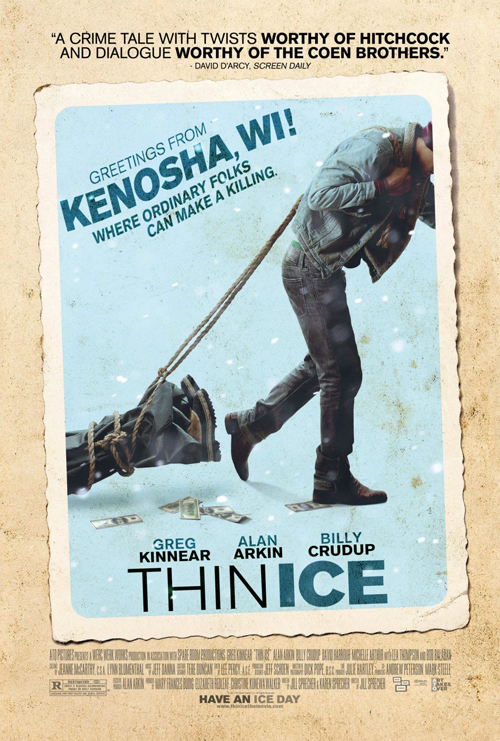
Taking place in…Wisconsin, I believe (I know it’s somewhere American, really cold, and really isolated, and not Alaska), the film tells the story of Mickey Prohaska (Greg Kinnear), a mildly successful insurance agent who loses a lot of money one weekend at a convention. His office isn’t doing too hot, and so in order to recuperate some of his losses, he cooks up a scheme to take advantage of Gorvy Hauer (Alan Arkin), an older farmer who Mickey has just duped into buying an insurance policy for his farm and house. At this point, things start to get weird—Gorvy goes away and has a security system installed by a guy named Randy Kinney (Billy Crudup). Then there’s a murder, in which Mickey is implicated, there’s a really expensive violin, and, well, $#!& goes down.
Perhaps the strangest thing (and also strongest aspect) that the movie has to offer is how everything that happens is downright hilarious. This is thanks mostly to the stupendous acting; Kinnear is phenomenal with his moral relativism and shady ethics, and Crudup‘s over-the-top desperation as things go from bad to worse is gut-wrenchingly funny (and I mean that in all senses of the word). There are also some great supporting parts played by David Harbour and Bob Balaban, two guys whose names you totally don’t know but whose faces you would recognize in a heartbeat. They’re all good, they’re all funny, and they’re all totally screwed up, which is another reason they’re so great.
However, I have some serious tiffs with the movie, most of which concern the ending. This movie might have been a really great sleeper hit, completely untarnished by the cold, clammy claws of Hollywood executives, if the ending wasn’t so bleedingly blatant. I mean, my GOD. I understand the need for catharsis and resolution at the end of a
The last 15 minutes of the film are so damn condescending that I almost walked out. Apparently, the collective IQ of our great nation has dropped so low that Hollywood now believes that it must explain every flipping point to us. There’s nothing for the audience to figure out, and thus, no sense of satisfaction. I mostly blame the narration, in which Mickey explains everything that happened step by step, holding the audience’s hand as it walks through the previously-intricately-layered levels of storytelling genius that had been going on.
Why, Hollywood, why? Why take an excellent story, full of wit, murder, and plenty of Billy Crudup screaming, and make it completely flat, right at the home stretch? Have faith in the audiences of America. We like a challenge. Remember Inception and how it made a preposterous amount of money, all because the ending was so deliciously unresolved that people wanted to see it again and again? Yeah. Do that. We liked that.
I go to films to think and be entertained. If I want something cold and tasteless served to me on a platter, I’ll get bad sushi.
Synopsis:
An insurance agent looking for a way out of frigid Wisconsin is blackmailed by an unstable locksmith in the theft of a rare violin that belongs to a retired farmer.